Last updated: August 18, 2026
Quick Answer
The FDA updated its Salmonella Enteritidis egg outbreak investigation on August 17, 2026, confirming the outbreak remains active. Midwest Poultry Services, L.P. recalled nearly 1.6 million dozen shell eggs produced in Texas, and the FDA elevated the recall to a Class I designation, its highest risk level, around August 12-14, 2026. At least 98 confirmed illnesses across 17 states have been reported, with 26 hospitalizations and no deaths as of the latest update. [2][6]
Key Takeaways
- The FDA Updates Salmonella Egg Outbreak Investigation This August marks the recall as a Class I risk, meaning there is a reasonable probability the product could cause serious harm or death. [3][4]
- Midwest Poultry Services, L.P. voluntarily recalled approximately 1,589,577 dozen white shell eggs and brown cage-free shell eggs on July 22, 2026. [1][7]
- Affected eggs were produced at Texas farms between June 6 and July 3, 2026, with “best by” dates ranging from July 20 to August 17, 2026. [1][2]
- Retail brands carrying recalled eggs include Kroger, Simple Truth, Brookshire’s, Cal-Maine, and Country Morning, sold in multiple pack sizes. [2][8]
- At least 98 laboratory-confirmed Salmonella Enteritidis infections across 17 U.S. states have been reported, with 26 hospitalizations. [6]
- The true number of cases is likely higher, as many people with Salmonella do not seek testing. [5][6]
- Consumers should check egg cartons for plant codes P-1950 or 0840962 and “best by” dates between July 20 and August 17, 2026. [1][8]
- Do not eat, sell, or serve any recalled eggs. Discard them or return them to the store and sanitize any surfaces that touched raw eggs. [6][8]
- Vulnerable groups, including young children, older adults, pregnant individuals, and immunocompromised people, face a higher risk of severe illness. [5][8]
- FDA, CDC, and state partners are conducting active traceback, on-site inspections, and environmental sampling at the Texas farms. [2][10]
What Is Salmonella and How Does It Spread in Eggs
Salmonella Enteritidis is a bacterial pathogen that can contaminate shell eggs in two primary ways: from inside the hen before the shell forms, or from fecal matter on the shell’s exterior. The Enteritidis strain is particularly associated with eggs because it can infect a hen’s ovaries and enter the egg during formation, making it invisible to the naked eye.
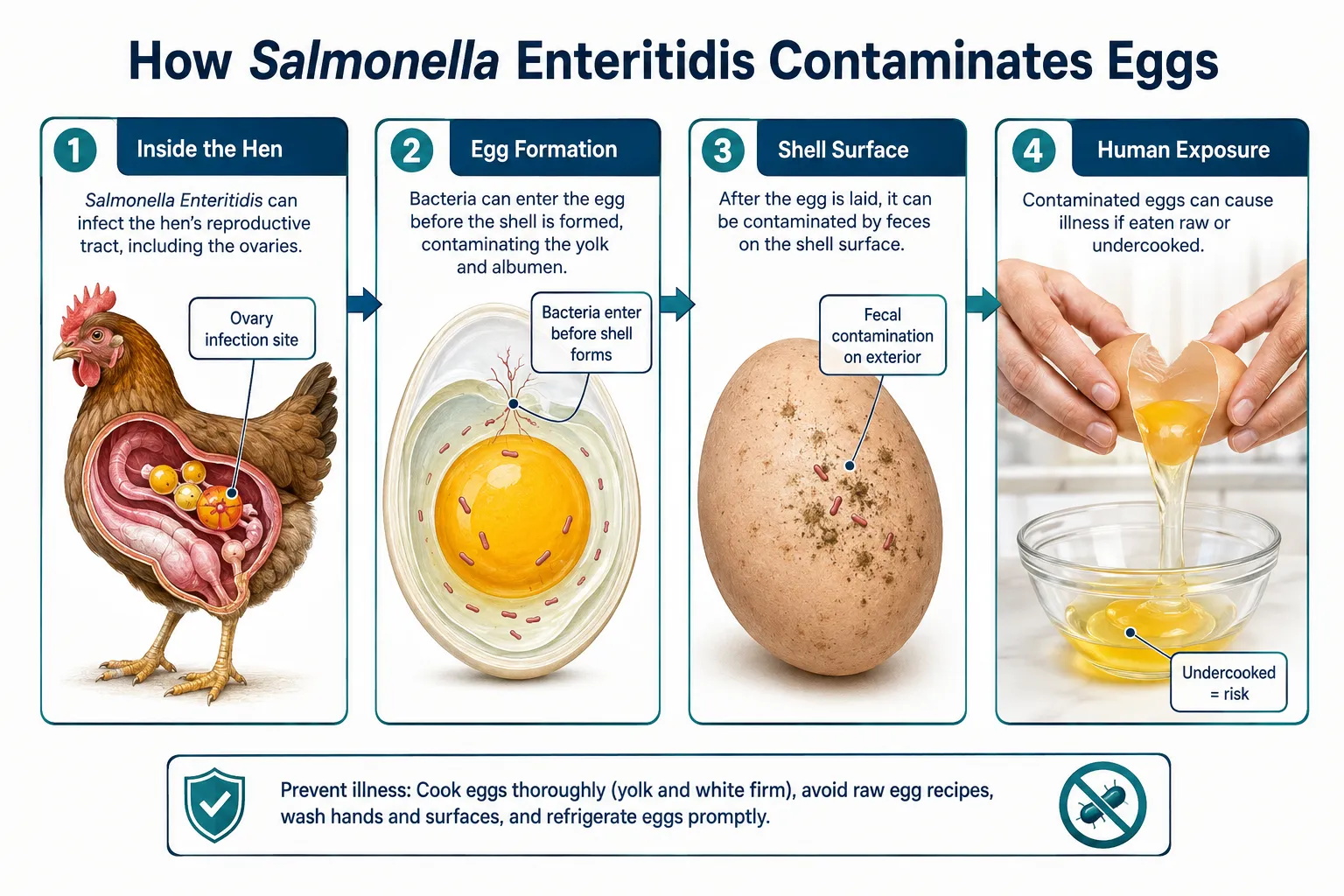
Key contamination routes include:
- Internal contamination: Bacteria infect the hen’s reproductive tract and enter the egg before the shell hardens.
- External contamination: Fecal matter on the shell surface can transfer bacteria when eggs are cracked.
- Cross-contamination: Bacteria from raw egg surfaces can spread to hands, utensils, and countertops.
Because infected eggs look and smell completely normal, consumers cannot detect contamination without laboratory testing. This is why FDA and CDC track outbreaks through illness surveillance and environmental sampling at farms. [2][6]
Salmonella Egg Outbreak Timeline: When Did It Start
The current outbreak began earlier than the recall date suggests. Illness onset dates in CDC’s investigation range from November 21, 2025, through June 30, 2026, indicating contamination was occurring months before the public recall. [3][6]
Key dates in the outbreak timeline:
| Date | Event |
|---|---|
| Nov 21, 2025 | Earliest recorded illness onset date |
| June 6, 2026 | Earliest production date of recalled eggs |
| June 10, 2026 | FDA lists outbreak investigation start date |
| July 22, 2026 | Midwest Poultry Services issues voluntary recall |
| Aug 12-14, 2026 | FDA upgrades recall to Class I status |
| Aug 17, 2026 | FDA dashboard updated; outbreak listed as active |
CDC notes that additional illnesses with earlier onset dates may still be added to the total as the investigation progresses. [6][15]
FDA Updates Salmonella Egg Outbreak Investigation This August: What the Latest Data Shows
As of August 17, 2026, the FDA’s outbreak investigations dashboard confirms the Salmonella Enteritidis egg outbreak is still active, with traceback, on-site inspections, and product and environmental sampling all underway. [10]
The most significant development in August 2026 is the FDA’s reclassification of the Midwest Poultry Services recall as a Class I recall, its most serious category. A Class I designation means there is a “reasonable probability” that consuming the product will cause serious adverse health consequences or death. [3][4][9]
Environmental sampling at the Texas production farms detected Salmonella, which directly contributed to both the initial recall and its subsequent escalation. [1][2][4] FDA is coordinating the investigation with CDC and state public health partners across the 17 affected states.
The 98 confirmed illnesses likely undercount the true burden of disease, because many people recover from Salmonella without ever seeking medical care or being tested. [5][6]
Which Egg Brands Are Affected and Which States Are Involved
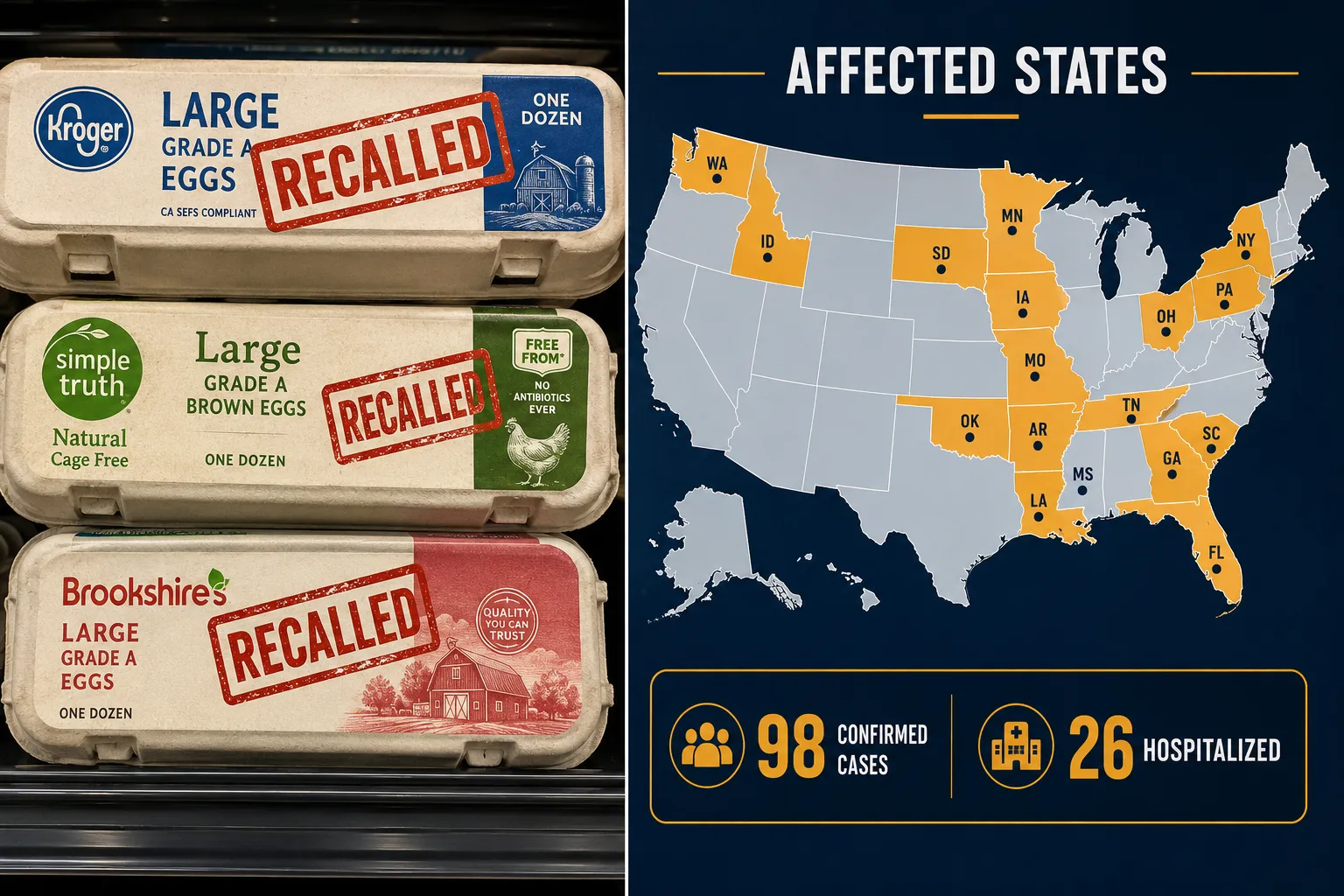
The recalled eggs were distributed under multiple retail and private-label brand names. Consumers should check their cartons against this list:
Affected brands (partial list):
- Kroger
- Simple Truth
- Brookshire’s
- Cal-Maine
- Country Morning
Eggs were sold in carton and flat sizes of 6, 12, 18, 24, 30, 36, and 60 eggs. [1][2][8]
How to identify recalled eggs:
- Plant codes: P-1950 or 0840962 on the carton
- “Sell by” or “best by” dates: July 20 through August 17, 2026
- Both conventional white shell eggs and brown cage-free shell eggs are included [1][2]
As of the latest CDC update, 17 U.S. states have reported confirmed illnesses. The outbreak is concentrated in the U.S. South and Southwest, consistent with the Texas-based production and distribution network. [3][6]
Symptoms of Salmonella Poisoning: What to Watch For
Salmonella Enteritidis infection typically causes diarrhea, fever, and stomach cramps. Symptoms usually begin 6 hours to 6 days after eating contaminated food and last 4 to 7 days in most healthy adults. [6]
Common symptoms:
- Diarrhea (sometimes bloody)
- Fever, often above 101°F (38.3°C)
- Stomach cramps and nausea
- Vomiting
- Headache
When to seek medical care immediately:
- Diarrhea lasting more than 3 days
- High fever (above 102°F / 38.9°C)
- Bloody stool
- Inability to keep fluids down
- Signs of dehydration: very little urination, dry mouth, dizziness
Vulnerable groups, including young children under 5, adults over 65, pregnant individuals, and people with weakened immune systems, are at significantly higher risk of severe illness and should seek care promptly. [5][8]
How Long Does Salmonella Last in the Body
Most healthy people recover from Salmonella infection within 4 to 7 days without antibiotic treatment. However, the bacteria can spread from the intestines to the bloodstream in severe cases, which can be life-threatening and requires hospitalization. [6]
Of the 98 confirmed cases in this outbreak, 26 people were hospitalized, a hospitalization rate that reflects the severity of Salmonella Enteritidis infections. No deaths have been reported as of August 17, 2026. [3][6]
Can You Cook Salmonella Out of Eggs
Yes, thorough cooking kills Salmonella Enteritidis. The bacteria are destroyed when eggs reach an internal temperature of 160°F (71°C). However, this does not apply to recalled eggs in the current outbreak.
FDA and CDC guidance is clear: Do not eat recalled eggs regardless of how they are cooked. The recall covers all eggs with the identified plant codes and date ranges, and consumers should discard or return them rather than attempt to cook them. [6][8]
For non-recalled eggs, safe cooking practices include:
- Cook eggs until both the yolk and white are firm, not runny.
- Avoid dishes that use raw or undercooked eggs (Caesar dressing, homemade mayonnaise, soft-scrambled eggs) if serving vulnerable individuals.
- Use a food thermometer to verify egg dishes reach 160°F.
Is pasteurized egg safer during an outbreak? Pasteurized shell eggs or liquid egg products have been heat-treated to kill Salmonella before packaging. During an active outbreak, switching to pasteurized eggs is a practical option for high-risk individuals who want additional protection.
What Should You Do If You Bought Recalled Eggs
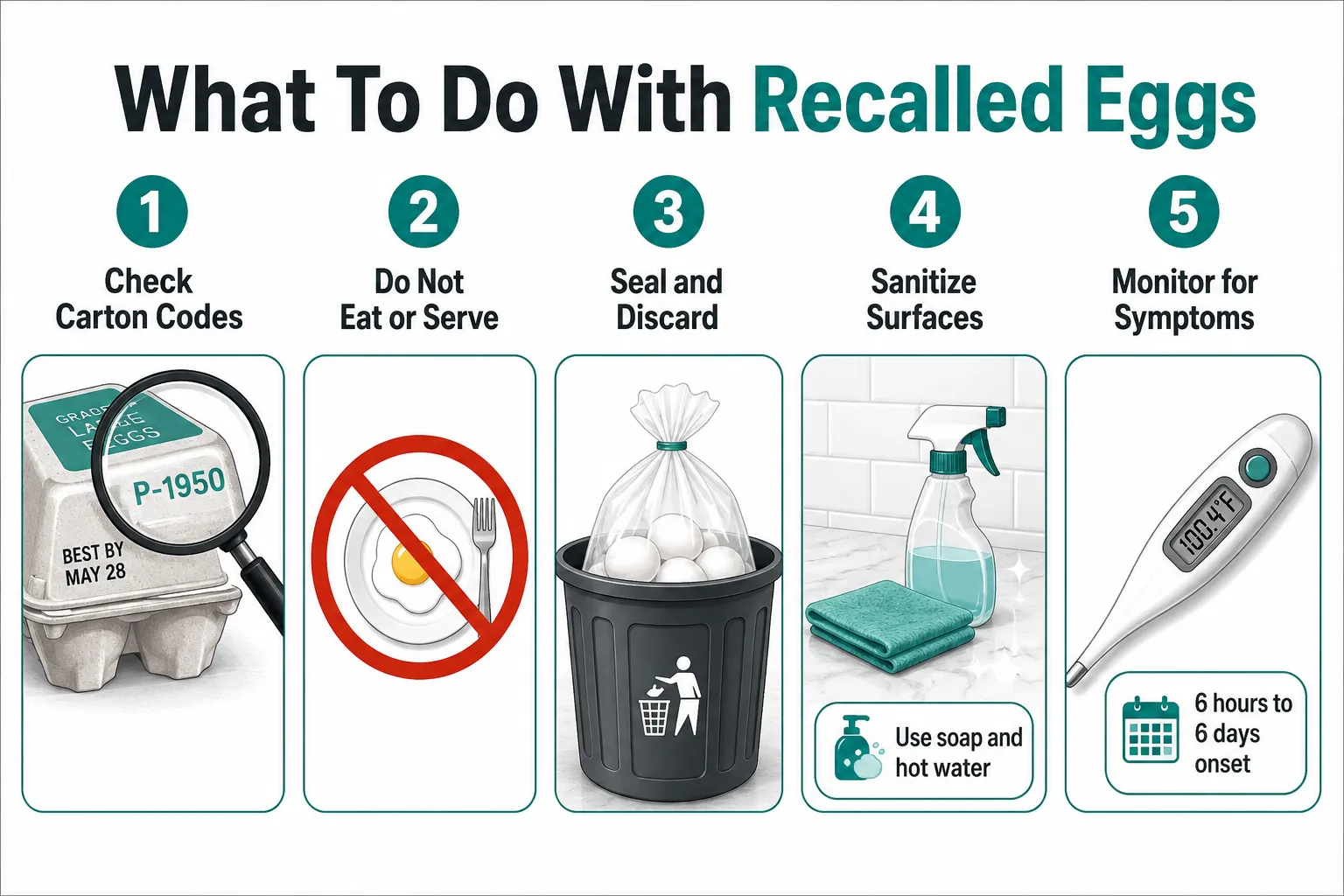
If you have eggs at home, follow these steps immediately:
- Check the carton. Look for plant codes P-1950 or 0840962 and “best by” dates between July 20 and August 17, 2026.
- Do not eat, serve, or sell the eggs. This applies even if the eggs appear normal and smell fine.
- Seal and discard. Place recalled eggs in a sealed bag and dispose of them in a covered trash container.
- Return for a refund. Alternatively, return the eggs to the place of purchase for a full refund. [6][8]
- Sanitize all surfaces. Wash any surfaces, containers, or utensils that may have contacted the recalled eggs with hot soapy water, then sanitize with a diluted bleach solution.
- Wash hands thoroughly. Use soap and warm water for at least 20 seconds after handling raw eggs or cleaning surfaces.
- Monitor for symptoms. If anyone in your household develops diarrhea, fever, or stomach cramps within 6 days of eating eggs, contact a healthcare provider.
If you are unsure whether your eggs are from the recall, treat them as suspect and check the FDA’s dedicated outbreak investigation page for the most current brand and code information. [2][10]
How Does FDA Test Eggs for Salmonella
FDA tests for Salmonella through a combination of environmental sampling at production facilities and laboratory analysis of product samples. In this outbreak, environmental sampling at the Texas farms confirmed the presence of Salmonella, which triggered and then expanded the recall. [1][2][4]
The agency’s investigation process includes:
- Traceback: Tracing confirmed illness cases back to a common food source through interviews and purchase records.
- On-site inspections: FDA inspectors visit production farms and packing facilities to assess sanitation practices and collect samples.
- Product sampling: Eggs from the facility are tested in certified laboratories for Salmonella contamination.
- Environmental sampling: Swabs from surfaces, equipment, and animal housing areas are tested to identify contamination sources.
All three activities are currently listed as ongoing on FDA’s outbreak investigations dashboard as of August 17, 2026. [10]
How to Prevent Salmonella Food Poisoning at Home
Beyond the current recall, several everyday practices reduce the risk of Salmonella from eggs year-round.
Storage:
- Refrigerate eggs at or below 40°F (4°C) immediately after purchase.
- Keep eggs in their original carton to reduce moisture loss and cross-contamination.
Handling:
- Wash hands before and after handling raw eggs.
- Do not use cracked or dirty eggs.
- Keep raw eggs away from ready-to-eat foods in the refrigerator.
Cooking:
- Cook eggs until yolks and whites are firm.
- Bring egg dishes like casseroles and quiches to 160°F (71°C).
- Refrigerate leftover egg dishes within 2 hours of cooking.
Shopping:
- Buy only refrigerated eggs from stores with clean, well-maintained coolers.
- Check cartons for cracks before purchasing.
- During active outbreaks, consider pasteurized eggs as an alternative.
Conclusion
The FDA Updates Salmonella Egg Outbreak Investigation This August represent a serious, ongoing public health situation. With nearly 1.6 million dozen eggs recalled, 98 confirmed illnesses across 17 states, 26 hospitalizations, and a Class I recall designation now in place, consumers need to act quickly and carefully. [1][3][5]
Actionable next steps:
- Check your refrigerator today for recalled eggs using plant codes P-1950 or 0840962 and “best by” dates between July 20 and August 17, 2026.
- Discard or return any recalled eggs immediately and sanitize all contact surfaces.
- Monitor household members, especially children, older adults, and pregnant individuals, for symptoms of Salmonella infection for up to 6 days after any potential exposure.
- Bookmark FDA’s outbreak investigation page at fda.gov for real-time updates as the investigation continues. [2][10]
- Practice safe egg handling and cooking habits year-round to reduce baseline risk.
The investigation is ongoing. FDA, CDC, and state partners are still collecting data, and additional recalled products or affected regions could be identified. Staying informed through official FDA and CDC channels is the most reliable way to protect your household.
FAQ
What is the current status of the Salmonella egg outbreak as of August 2026? The outbreak is active as of August 17, 2026. FDA and CDC are conducting ongoing traceback, inspections, and sampling. At least 98 illnesses across 17 states have been confirmed, with 26 hospitalizations and no deaths. [6][10]
Which eggs were recalled in the 2026 Salmonella outbreak? Midwest Poultry Services, L.P. recalled approximately 1,589,577 dozen white shell eggs and brown cage-free shell eggs produced in Texas between June 6 and July 3, 2026, with “best by” dates from July 20 to August 17, 2026. [1][7]
How do I know if my eggs are part of the recall? Check the carton for plant codes P-1950 or 0840962 and “best by” dates between July 20 and August 17, 2026. Affected brands include Kroger, Simple Truth, Brookshire’s, Cal-Maine, and Country Morning. [1][8]
What does a Class I FDA recall mean? A Class I recall is the FDA’s highest risk level. It means there is a reasonable probability that consuming the product will cause serious adverse health consequences or death. The egg recall was upgraded to Class I around August 12-14, 2026. [3][4][9]
Can cooking the recalled eggs make them safe to eat? No. FDA and CDC advise against eating any recalled eggs regardless of cooking method. Discard or return them. [6][8]
What are the symptoms of Salmonella Enteritidis infection? Symptoms include diarrhea, fever, stomach cramps, nausea, and vomiting. They typically appear 6 hours to 6 days after exposure and last 4 to 7 days in healthy adults. [6]
Who is most at risk from this outbreak? Young children under 5, adults over 65, pregnant individuals, and immunocompromised people face the highest risk of severe illness and should seek medical attention promptly if symptoms appear. [5][8]
Are pasteurized eggs safe during this outbreak? Pasteurized eggs have been heat-treated to kill Salmonella and are a safer option during an active outbreak, particularly for vulnerable individuals. They are not part of the current recall.
How many states are affected by the 2026 Salmonella egg outbreak? As of the latest CDC update, 17 U.S. states have reported confirmed illnesses linked to this outbreak. [6]
Is this the same outbreak as the 2025 August Egg Company recall? No. The 2025 August Egg Company outbreak was a separate incident that has been declared over. The current 2026 outbreak involves Midwest Poultry Services, L.P. and remains under active investigation. [2][10]
What should I do if I already ate recalled eggs? Monitor yourself for symptoms for up to 6 days. If you develop diarrhea, fever, or stomach cramps, contact a healthcare provider. Seek immediate care if symptoms are severe or if you are in a high-risk group. [6]
Where can I find the most current information on this outbreak? Visit FDA’s dedicated outbreak investigation page at fda.gov/food/outbreaks-foodborne-illness/outbreak-investigation-salmonella-eggs-july-2026 and CDC’s investigation page for the latest updates. [2][6]
References
[1] Midwest Poultry Services Lp Recalls Shell Eggs Due Possible Salmonella Enteritidis Contamination – https://www.fda.gov/safety/recalls-market-withdrawals-safety-alerts/midwest-poultry-services-lp-recalls-shell-eggs-due-possible-salmonella-enteritidis-contamination
[2] Outbreak Investigation Salmonella Eggs July 2026 – https://www.fda.gov/food/outbreaks-foodborne-illness/outbreak-investigation-salmonella-eggs-july-2026
[3] Egg Recall Us South And South West Salmonella Outbreak – https://www.theguardian.com/us-news/2026/aug/15/egg-recall-us-south-and-south-west-salmonella-outbreak
[4] Fda Egg Recall Salmonella – https://www.nytimes.com/2026/08/14/health/fda-egg-recall-salmonella.html
[5] Eggs Recalled For Salmonella Upgraded To Highest Fda Risk Level – https://time.com/article/2026/08/15/eggs-recalled-for-salmonella-upgraded-to-highest-fda-risk-level/
[6] Investigation – https://www.cdc.gov/salmonella/outbreaks/shell-eggs-07-26/investigation.html
[7] Poultry Firm Recalls Nearly 16 Mln Dozen Eggs Over Potential Salmonella Us Fda 2026 07 23 – https://www.reuters.com/legal/litigation/poultry-firm-recalls-nearly-16-mln-dozen-eggs-over-potential-salmonella-us-fda-2026-07-23/
[8] Salmonella Eggs Recall August 2026 Rcna591058 – https://www.nbcnews.com/select/shopping/salmonella-eggs-recall-august-2026-rcna591058
[9] 15 Million Dozen Recalled Eggs Receive Fdas Highest Risk Warning – https://www.washingtonpost.com/health/2026/08/14/15-million-dozen-recalled-eggs-receive-fdas-highest-risk-warning/
[10] Investigations Foodborne Illness Outbreaks – https://www.fda.gov/food/outbreaks-foodborne-illness/investigations-foodborne-illness-outbreaks
Leave a Reply